
Be yourself; Everyone else is already taken.
— Oscar Wilde.
This is the first post on my new blog. I’m just getting this new blog going, so stay tuned for more. Subscribe below to get notified when I post new updates.
Be yourself; Everyone else is already taken.
— Oscar Wilde.
This is the first post on my new blog. I’m just getting this new blog going, so stay tuned for more. Subscribe below to get notified when I post new updates.


Mt. Ololokwe – Old Africa’s Mystery Mountain.
”The obligatory Mt. Ololokwe. It’s a sin to go through this road and not take this photo. It’s like flying and not taking the plane wing photo. I cannot trust people who do not keep up with our travel traditions.”
It is a distinctive mountain overlooking the Samburu plains in Northern Kenya, her beauty calls you from the highway and if you have been on this road you must have made a mental note that you will be back to experience HER.


The Samburu, just like the Maasai are a semi-nomadic people. Only the Samburu are still very traditional and have not parted with old customs as compared to the Maasai. Let us then have a look at five interesting lifestyle facts about the Samburu that you probably don’t know.
1)Diet
Cattle, as well as goats, sheep and camels, play a vital role in the Samburu way of life and culture (the camels are kept for their milk rather than their meat.). The Samburu are highly dependent on their livestock for survival.Their diet comprises mostly of milk and occasionally blood from their cows.Theblood is acquired by slightly cutting the jugular of the cow, and draining the blood into a cup. The wound is then promptly sealed with hot ash. Meat is only served on special occasions. The Samburu people’s diet is also supplemented with vegetables, roots and tubers that are made into a soup.

2) The Samburu settlements
The land habited by the Samburu is mostly dry barren land, and the Samburu tribe has to relocate to be certain their cattle have enough food. Every few weeks the tribe will change location to find fresh grazing grounds (known as ‘fora’ in the local dialect).
The Samburu have altogether smaller settlements containing typically four independent families living in six or seven huts. A settlement with as many as fifteen huts is a large one by their standards. The fact that families are essentially independent is significant. It introduces a degree of flexibility into the organization of the settlement, and as the seasons change, so individual elders may choose to migrate with other families or separately. The social advantages of large settlements are to them less important than the economic disadvantages: cattle do not go as far afield to graze as camels, consequently the land around a large settlement will be exhausted more quickly and it will be necessary to migrate more often. Even individual herds may become too large and unwieldy to manage, and under these circumstances, an elder will often divide his herds and family into two economically independent units. These may even live in different settlements and in different vicinities.
The Samburu clans tend to be scattered over much of the tribal territory in interspersed clusters of small settlements. Huts are constructed using hide, mud, and grass mats strung over poles. The roof is made of a matrix of stretched out carton boxes, animal hide and tattered clothes. Underneath these boxes, or on top of them, there may be a polythene paper to provide insulation against the rare rain. A fence is built around the mud huts for protection from wild animals. The Samburu tribe settlements are called manyattas.

3) The duties and obligations of each family member
a) The women
Samburu women are responsible for gathering firewood, vegetables and roots, caring for their children and collecting water. They actually do the bulk of the daily jobs as opposed to their male counterparts who spend their day playing a local board game or in idle chatter (the morans look after their cattle herds and the older men are left in the settlement with their wives and children from younger brides). Custom permits a woman to have discreet sexual relations with men other than her husband, in particular those of his age-set or alternation. However, from the moment that her pregnancy is established, she should only have intercourse with her husband and this too should be curtailed in time. As she loses her appetite for milk she is fed increasingly on meat, and, today, maize-meal.

b) The children
To the Samburu, children are more than a security for their parents against the coming of old age. They are a focus of interest and attention. Their presence is the only certain thing that can stabilize marriage. They enhance the status of the parents, and the more there are of them the more propitious the family is thought to be. With a number of children, especially sons, a man can hope to build up his herds and in time to lead a less active life in herding and a more active life in the gossip groups of the elders and (if he wants) in their more formal discussions. While his daughters, after their marriages into worthy families, are an asset to him and his closer kinsmen: he can look to their allotted herds for an added source of revenue. The preference for polygamy implies that wives are in more constant demand and that their inherent value is higher than among the Rendille neighbors. Consequently, there is less need for the Samburu to apply pressure on their girls in order that they should acquire the qualities ideal in a wife: their future is more assured.

c) Girls
Samburu girls usually help their mothers with the domestic chores such as fetching water and cooking. Girls train for motherhood at an early age by helping with the household chores, and caring for their siblings. When adolescent girls attend dances organized by the moran of their clan they are acutely aware of the importance of looking their best at such gatherings. They paste ochre onto their shaven heads, darken their eyebrows with charcoal, and paint intricate designs on their faces. She is then likely to earn praise from a moran, probably becoming a mistress to him and enjoying his protection. This relationship is forged by mutual physical and sexual attraction, although each knows that their relationship has no future. Since both come from the same clan, marriage is forbidden. Over the years the moran will heap beads upon his lover or bead girl (Shanga girl) as a symbol of his love and whilst the girls may feel passionately about a certain man, they are taught from an early age that these feelings are irrelevant, for they will never be able to wed someone of their own choosing (be sure to find out more about the Samburu marriage in a later blog post). Girls are taught that the marriage bond is not based on physical attraction or emotion, but instead that it is a long term sound investment forged by her family.

d)Boys
On the other hand, boys look after livestock in close proximity to the village settlements which are needed for daily supply of milk, blood and food for the settlement, the larger heard being with the morans several kilometers away from these settlements. Sometimes they also join the morans in their nomadic journeys for short periods. They are also the ones sent to take food, medicine and other resources to the morans in ‘fora’. Tracing the exact location is really hard and requires tracking skills such as dung and hoof print extermination. It is now easy where there is cellular reception. The boys grow up adoring the morans as they eagerly wait to themselves become morans after circumcision. They told me stories of the present morans and those of days past with such excitement and an almost godly worshipful tone. I especially remember praises heaped on one sharp shooter moran who can never miss a target using his rifle or AK (they posses guns for protection against cattle rustlers from the neighboring communities such as the Turkana and Gabras. Check previous article on the Samburu history for a better understanding of this). Once a boy has been circumcised he is now considered a Moran (a warrior). The men are placed into age sets, and as a group move from one social position to another. From child to Moran, to junior elder and finally to elder.

e) The Moran
The morans(Samburu warriors) look after the cattle and are generally responsible for the overall safety of the community. We will have an in-depth look of the Moran stage later in another blog post.

f) Samburu Elders
The senior age-set is responsible for the moral education of the junior and for inculcating a sense of respect. Among the Samburu this is known as the firestick relationship (olpiroi) and the elders responsible for the current age-set of moran are known as the firestick elders. We shall have an in-depth look at this when we study moranhood.
The Samburu are a gerontocracy, the elders rule the tribe. It is the elders that decide when ceremonies will occur, such as weddings and circumcisions. Entry into womanhood and manhood is marked with a circumcision ceremony. Men and women are only able to get married once they have been circumcised, as prior to that they are still considered as children.

4) The Samburu Dances
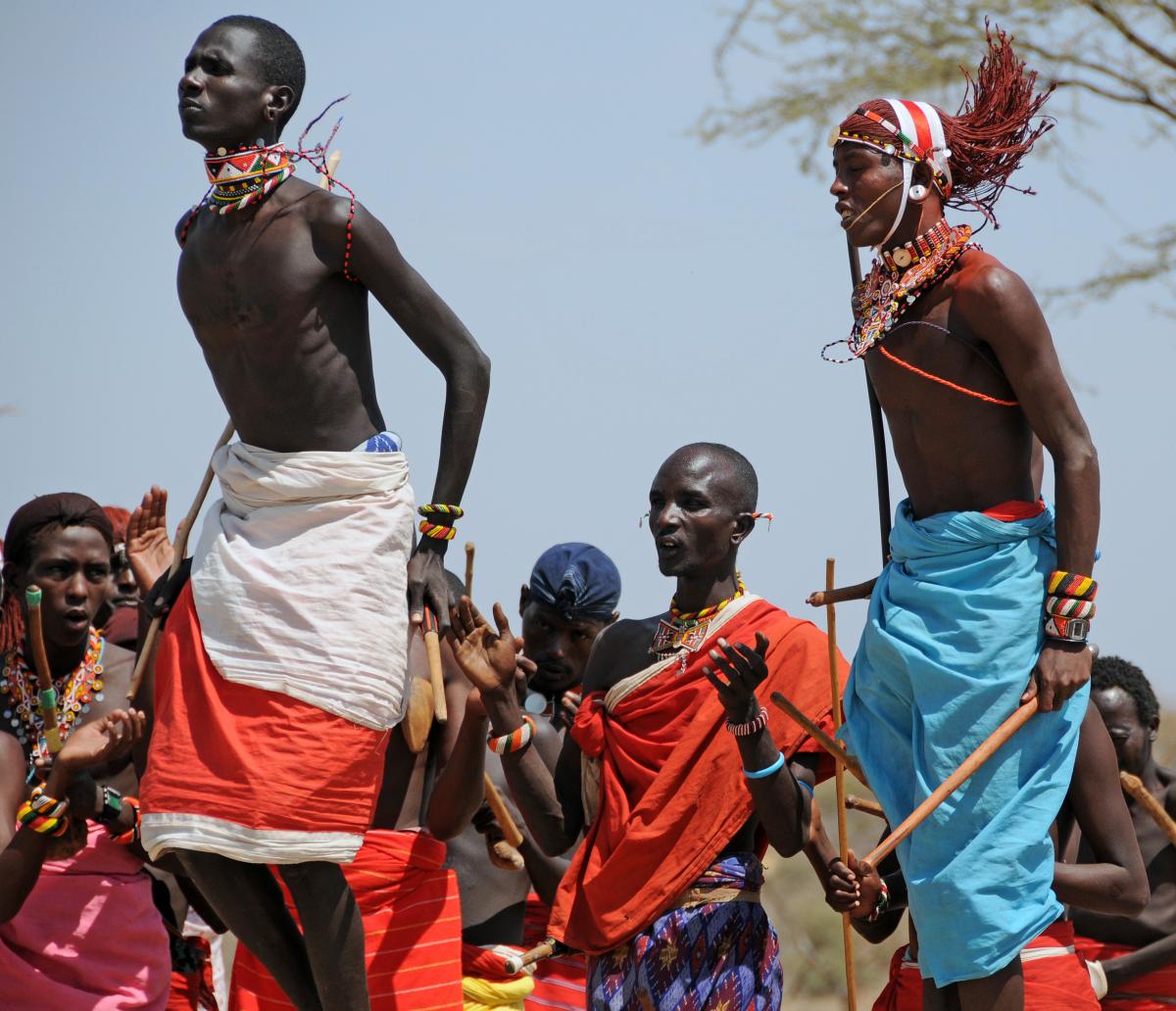
Dancing is a significant part of Samburu culture. They love to sing and dance, but traditionally use no instruments. They have dances for various occasions of life. The men dance jumping and high jumping from a standing position. Most dances involve the men and the women dancing in their separate circles with particular moves for each sex, but coordinating the movements of the two groups. They however come together in other occasions such as wedding ceremonies. A lot of their dances include elaborate movements of their head.

5) The Samburu fashion
When it comes to their dress code, the Samburu people are often recognized for their riveting beauty and decorative appearance. Their cousins- the Maasai- refer to them as the “butterfly people” because of their layers and layers of bead-covered jewelry, fascinating face painting, and colorful dress. The Samburu clothing is something that I found really interesting. Both men and women wear extremely bright colours. This may be because they want to add some life to the otherwise barren landscape or to make their dark skin glow. They adorn themselves with necklaces, bracelets and anklets. The traditional dress of the Samburu tribe is a striking red cloth wrapped like a skirt and a white sash( though there are variations of yellow and other bright colours}. This is adorned with many colorful beaded earrings, bracelets, anklets and necklaces. Each piece of jewellery worn represents the status of the wearer.

The warrior men (moran) cover their head in red ochre. The elders (both men and women) are clean shaven but the women also have a peculiar hairstyle whereby they shave their hair in a perfect circle. The women wear numerous necklaces and bracelets and these ornaments are made from colorful beads (used to be colorful seeds a long time back). It is said that the more beads or necklaces are there on a woman, the more beautiful she is considered. Another point on the same line of thought is that, women wear more necklaces as they get richer. Therefore, the number of beads or necklaces indicates status in society, richness level and beauty.

With their necks encircled with beads, their chins painted red with ochre and massed bracelets jangling on their wrists, the Samburu women are a beauty to behold. But while the beads might look pretty, the elaborate jewellery is more than mere decoration. For not only does it denote wealth, it also reveals subtle clues about status as well. Beads are worn mainly for their beauty, but they also tell you about relationships and special events. ‘Marnay’ bracelets are worn by everybody and are made of beads and bits of old tires. Most wear brass anklets too. Samburu girls are given strings of beads by their fathers from a very young age. The first layers of necklaces are usually red, as it means the girl is engaged which takes place at a very young age.
Women who are married wear elaborate brass earrings and layer of necklaces, the colours of which have different meanings and reflect her status.
Married women also wear elaborate headdresses made from entai (buttons), ntarangrang (sequins) , synthetic flowers of late (readily available from the mass producing Chinese industry)and sayen (beads) to show off their status and their husband’s wealth.
But it’s the beads that offer the most clues to a Samburu woman’s lifestyle, with different colours revealing different aspects of her personality, status and health. White stands for purity and good health because it represents milk which comes from a cow, black is hardship, yellow and orange melded signify hospitality because they are the colours of animal skins laid out on guest beds. Red signifies danger, bravery and unity.

Necklaces can even have magic powers, they believe. If a woman is sterile, she must see a witch doctor (oloibon) who will give her a collar of pearls. She must go to the first born man in any house, tie him up with the necklace and then leave with it. Three months later, she ought to be pregnant, while the man that she tied up with the necklace will become crazy or sick as in Samburu culture, the fortune of one will be the misfortune of the other ( again, a later article will describe the Samburu beliefs).
Beads are placed around the neck and waist of the infant after about two months. Those around the waist are discarded as the child grows up.
This then brings us to the end of the Samburu lifestyle overview. I do hope it was informative
Samburu peoples are pastoralists whose life has been revolving around the wellbeing of their goats, sheep, cattle, and in the more arid areas, camels. The Samburu are culturally related to the Maasai, and show a specifically rich and picturesque heritage of artful beadwork, songs and dances. Both women and warriors wear red dresses, but it is only the moran, the young fighters, who braid their hair as the skin is smeared with ochre, displaying an unmatched beauty of traditional Africa.
The Samburu share their Nilotic roots with the Pokots, their neighbors to the west, and the Turkana to the northwest, whereas Borana in the southeast and Rendille in the northeast are both of Cushitic lineage. Yet, culturally, the Rendille are the closest to the Samburu and practice almost identical traditions.

Northern Kenya is a land full of surprises!
The majestic mountain at the road’s horizon that tells you “Welcome to Samburu County”.
Mt. Ololokwe (also known as Ol Donyo Sabache) is officially my best hike yet; for two reasons-The views at the summit (sunrise) were magical to say the least and the hike started at 3:30am which was an exciting first for me.

The mountain is located few kilometers away from Archers Post, Samburu East and is around 2000m ASL at its peak.
Mount Ololokwe has incredibly a stunning view which is bound to take your breath away. Don’t ever imagine ignoring the photo request from this mountain.
Oblige it!
LOCATION
Samburu National Reserve is situated at the southeastern corner of Samburu District in the Rift Valley Province of Kenya. It is bordered to the south by Ewaso Nyiro River, which separates it from the Buffalo Springs National Reserve.
The reserve covers an area of 165 Km² and is located around 345Km from Nairobi.
Climatic Conditions
The Reserve lies within ecological zone V- which is classified as arid and semi- arid with moisture index of 42 to 57, which indicate that evapo-transpiration is greater than available moisture. The days are extremely hot while the nights are cool. The annual mean temperatures range between 18ºC and 30ºC, while the mean annual rainfall is 354mm with peaks in November and April. The dry season starts in late May, and goes up to early October during when large concentration of wildlife is found in the reserve due to availability of lush vegetation along the Ewaso Nyiro River, the main source of water to the Reserve and the nearby communities.
Available games (and chances of seeing )
The reserve is reach in wildlife with fame for abundance in rare northern specialist species such as the Grevy Zebra, Somali Ostrich, Reticulated Giraffe, Gerenuk and the Beisa Oryx (Also referred as Samburu Special). The reserve is also popular with a minimum of 900 elephants. Large predators such as the Lion, Leopard and Cheetah are an important attraction (Kamunyak the Miracle Lioness that adapted the baby Oryx is a resident in the reserve). Wild dog sightings are also a common attraction to this unique protected area. Birdlife is abundant with over 450 species recorded. Birds of the arid northern bush country are augmented by a number of riverine forest species. Lesser Kestrel and the Taita Falcon are species of global conservation concern and they both utilize the reserve. Five species categorized as vulnerable have recorded in the reserve. These are African Darter, Great Egret, White-headed Vulture, Martial Eagle and the Yellow-billed Ox-pecker. Critically endangered species under CITIES – Pancake tortoise (malacochersus tornieri) is found in the reserve.

Like in other African cultures, in the Samburu culture the transition from one stage of life to another or change of marital status are events that are accompanied by rituals and ceremonies that have their roots in the ancient tradition.
The Samburu children, or Layeni in Samburu language, do not have a role in the society, the only task that is entrusted to them is to lead goats to grazing; only after the initiation ritual they are entering a stage of maturity and play an active role.
The initiation ritual for the Samburu establishes the transition to adulthood and consists, like in other populations, in the practice of circumcision, a ceremony that takes place around the age of 15.
During the ceremony the boy is shaved, is given new shoes and is covered with a sheepskin on which the mother has previously sprinkled grease and coal dust. Circumcision is practiced at the door of the boy’s home with the assistance of an elder, and like for the Maasai, the boy should not show fear and emit no moan of pain as proof of his courage.
After the ceremony the young man receives gifts, food, and a bow and arrows; his mother wears a necklace made with black and white beads that indicates that since then his son has become a moran or lmorran, i.e. a true warrior.
For the time it takes him to recover, usually a month, the young man stays in his mother’s hut, after that he leaves the village and learns to hunt birds with the bow and arrows received as a gift. When Moran warriors return to the camp, they are blessed by their mothers with an ostrich feather soaked in milk; a ceremony is also held, during which a bull is killed and the young man must swear not to eat meat in the presence of women and from that moment onwards he begins to smear red ocher on his body.
Each moran chooses a new name and a rite is held, to celebrate this passage of the Samburu life; the celebration includes the sacrifice of an ox that is killed by suffocation: the animal, however, should not fall to the ground, it must be held up by the young people for whom the ceremony is celebrated, as a demonstration of their strength. The main occupation of a moran is to defend the cattle, this involving planning raids in the villages of rival ethnic groups to steal their livestock.
After 10 years of their lives spent as warriors, the Samburu boys move on to the next step and become ipayan, i.e. young elders, a stage of life when they get married and have children.
The ceremony, called imugit in the local language, that marks this passage, consists of sacrificing an ox the meat of which is eaten up completely and the bones are burnt; at this point the moran age-set terminates and this passage is over only after the tribal haircut. Marriage entails a complex ritual, that begins with the groom engaging in negotiations with the bride’s family to obtain the consent to marriage. The groom is required to deliver eight oxen to the future father-in-law as a pledge and procure gifts to be donated to the bride; great care is given in the preparation of the gifts, which usually consist of two goatskins, two copper earrings, a milk container and a sheep.
The groom will also provide several heads of cattle to be sacrificed during the marriage ceremony.
According to tradition, on the wedding day, at dawn, the bride is practiced clitoridectomy, but fortunately today this practice has almost disappeared. The groom leads the cattle to the house of the bride’s mother, and when the animals are killed, the marriage is considered celebrated. The wedding party begins with the division of the ox meat while the elderly bestow blessings and put butter on the head of the bride’s father.
The next day the bride must leave her mother’s house and move to her husband’s village, she has to travel all the way to her new home without ever looking back; on her arrival two lines of elderly bless the new couple.
In the new hut the bride lights up the fire, using two sticks rubbed over dried donkey dung: the fire should not go out until the new family moves elsewhere. The taboo according to which the bride should not look back on her way to her new house is associated with a Samburu legend, that tells how the elephants were once human beings.The legend tells that once upon a time a young bride was about to get ready to leave her family’s house and her father gave her precise instructions on how to follow her way, that included the prohibition to look back; but the girl was so sad that she could not resist to take a last glance at the home where she had grown up.During the night, the Nkai God, furious with the disobeying girl, decided to punish her: the body of the young girl began to swell and grow up until it broke the hut roof and finally turned into a majestic elephant.The Samburu believe that all elephants descend from this first girl-become-elephant and that the elephant and the Samburu people have the same blood ties. The popular belief tells that, if the elephants find a dead man they place bundles of grass or branches on his grave, and similarly if a Samburu comes across an elephant skull, he takes a bundle of green grass, spits on it and rolls it inside the cavities of the skull; this is considered a sign of respect and blessing: the green grass is the symbol of peace, while the spit is the rain, that is considered a divine gift in these areas. Another rite practiced by the Samburu concerns female fertility, that is regarded as one of the greatest values.
In the case of infertility, the wizard performs a fertility ritual that consists of placing a mud figure at the front of the door of the woman’s house to keep evil spirits away; a week later, a ceremony is organised, during which the husband invites the entire village, sacrifices a bull whose fat is smeared on the belly of his wife while she recites the “God will give you a son” prayer. A childless woman is mocked by people and insulted; the walls of her hut are smeared with cow dung. Even death has its ceremony, although the Samburu usually do not bury their own dead; as a matter of fact, only the very elderly and children before one year of age are buried.Once dead, the elderly are shaved and placed on the skin they used for sleeping with their face turned towards the sacred mountain, the residence of their God; the burial place is not far from the village, the tomb is recognisable so that people can identify it and place a green sprig as a sign of greeting. A dead child is buried inside the hut, close to the fire, after this the hut is abandoned by the family. The corpse of all those who are not buried are left on the ground outside the village.


The Samburu people are some of the friendliest in Kenya. Originally a nomadic tribe, the Samburu today still embraces their nomadic culture while jointly running some of the best Kenya game lodges.
The Samburu tribe lives north of the equator in the geographically fascinating Samburu County of Northern Kenya. The Samburu people are closely related to the Maasai tribe who also live in East Africa. Both these tribes speak a similar language, derived from Maa.
The Samburu, just like the Maasai are a semi-nomadic people. Only the Samburu are still very traditional and have not parted with old customs as compared to the Maasai. Cattle, as well as goats, sheep and camels, play a vital role in the Samburu way of life and culture. The Samburu are highly dependent on their livestock for survival. Their diet comprises mostly of milk and occasionally blood from their cows.
The blood is accrued by slightly cutting the jugular of the cow, and draining the blood into a cup. The wound is then promptly sealed with hot ash. Meat is only served on special occasions. The Samburu people’s diet is also supplemented with vegetables, roots and tubers that are made into a soup.
Samburu County is mostly dry barren land, and the Samburu tribe have to relocate to be certain their cattle have enough food. Every few weeks the tribe will change location to find fresh grazing grounds. Huts are constructed using hide, mud, and grass mats strung over poles. A fence is built around the mud huts for protection from wild animals. The Samburu tribe settlements are called manyattas . The Samburu usually dwell in groups of five to ten families. Traditionally Samburu men look after their cattle and they are also responsible for the overall safety of the tribe.
Samburu women are responsible for gathering vegetables and roots, caring for their children and collecting water. Samburu girls usually help their mothers with the domestic chores. The Samburu are a gerontocracy, the elders rule the tribe. It is the elders that decide when ceremonies will occur, such as weddings and circumcisions. Entry into womanhood and manhood is marked with a circumcision ceremony. Men and women are only able to get married once they have been circumcised, as prior to that they are still considered as children.
Once a boy has been circumcised he is now considered a Moran (a warrior). The men are placed into age sets, and as a group move from one social position to another. From child to Moran, to junior elder and finally to elder.
The traditional dress of the Samburu tribe is a striking red cloth wrapped like a skirt and a white sash. This is adorned with many colorful beaded earrings, bracelets, anklets and necklaces. Each piece of jewellery worn represents the status of the wearer.
Dancing is a significant part of Samburu culture. Their dancing is similar to that of the Maasai people with men dancing in a circle and jumping high from a standing position. Traditionally, the Samburu have not used any instruments to accompany their dancing and singing.
Just like the Maasai tribe, the Samburu people are under pressure from their government to settle into more permanent villages. They have resisted this proposal thus far, since a permanent settlement would disrupt their entire way of life. And it will be difficult to grow and maintain crops on a permanent site.
The Samburu live in a very beautiful, sparsely populated part of Kenya with abundant wildlife. Much of the land is now protected and community development initiatives have extended to eco-friendly African lodges jointly run by the Samburu. As a visitor, the best way to get to know the Samburu is to stay at a community run lodge, or enjoy a walking or camel safari with Samburu guides.


This is an example post, originally published as part of Blogging University. Enroll in one of our ten programs, and start your blog right.
You’re going to publish a post today. Don’t worry about how your blog looks. Don’t worry if you haven’t given it a name yet, or you’re feeling overwhelmed. Just click the “New Post” button, and tell us why you’re here.
Why do this?
The post can be short or long, a personal intro to your life or a bloggy mission statement, a manifesto for the future or a simple outline of your the types of things you hope to publish.
To help you get started, here are a few questions:
You’re not locked into any of this; one of the wonderful things about blogs is how they constantly evolve as we learn, grow, and interact with one another — but it’s good to know where and why you started, and articulating your goals may just give you a few other post ideas.
Can’t think how to get started? Just write the first thing that pops into your head. Anne Lamott, author of a book on writing we love, says that you need to give yourself permission to write a “crappy first draft”. Anne makes a great point — just start writing, and worry about editing it later.
When you’re ready to publish, give your post three to five tags that describe your blog’s focus — writing, photography, fiction, parenting, food, cars, movies, sports, whatever. These tags will help others who care about your topics find you in the Reader. Make sure one of the tags is “zerotohero,” so other new bloggers can find you, too.

 Burtean